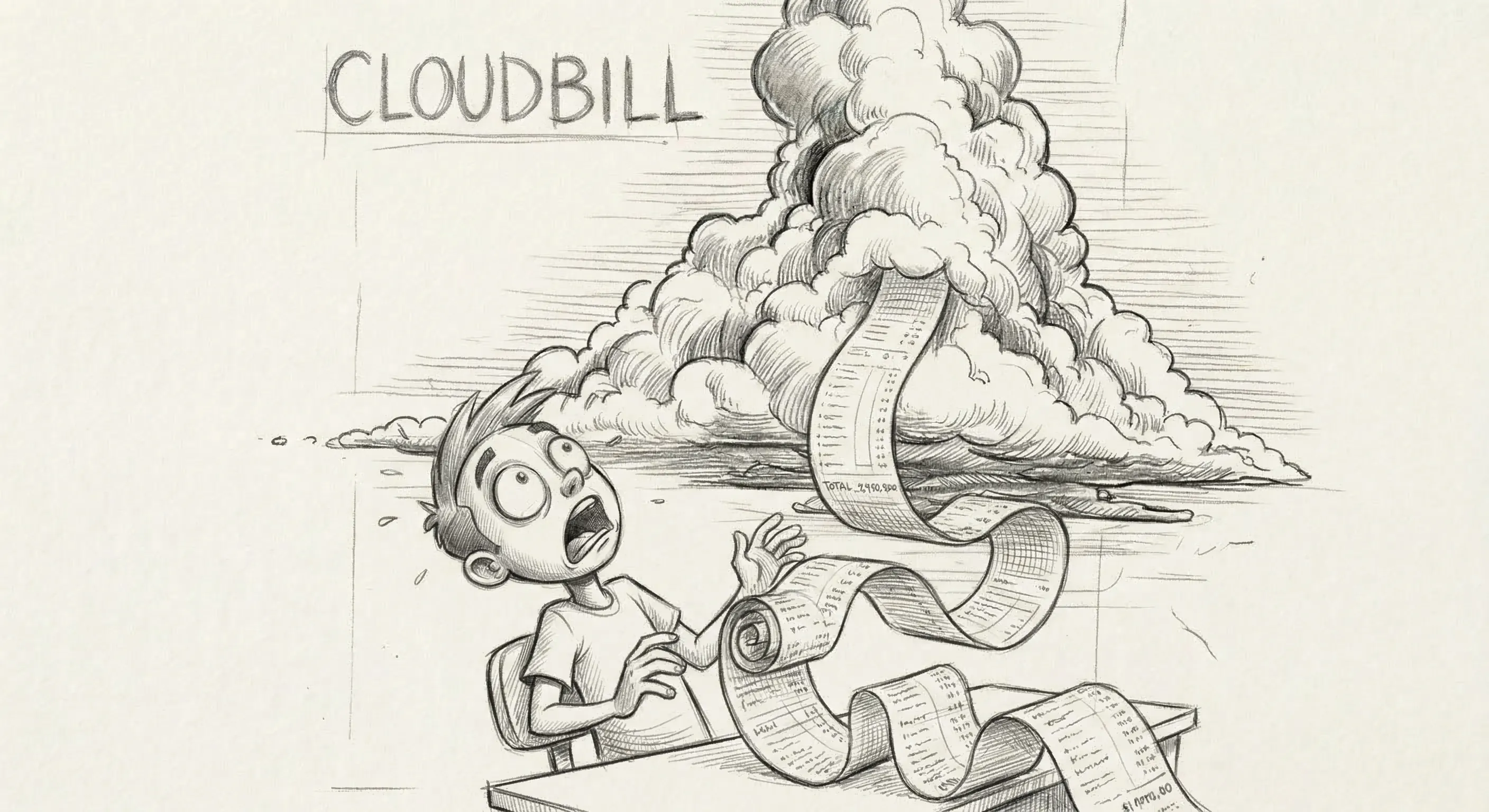
The Cloud Bill That Broke the Budget: Why Cost Management Must Start on Day One
There is a moment most IT leaders know well. The cloud migration is live, the team is shipping faster than ever, and the infrastructure feels modern, elastic, and full of potential. Then the bill arrives. Not the first one, that one seems reasonable. But six months later, after a few product launches, a couple of load tests, and a handful of engineers spinning up environments "just to try something," the monthly invoice has quietly tripled.
This is not an edge case. It is one of the most predictable failure modes in cloud adoption, and it is nearly always the result of decisions made 'or not made' at the very beginning.
The Silent Spiral: How Cloud Costs Grow Without Anyone Noticing
Cloud platforms are engineered for frictionless consumption. Spinning up a new server, a managed database, or a machine learning endpoint takes minutes and requires no capital approval. That frictionlessness is genuinely valuable, but it also means that spending accumulates at a pace that traditional IT procurement processes were never designed to monitor.
The pattern is consistent across industries. A development team creates a staging environment and forgets to decommission it after the project ships. An auto-scaling group is configured with generous upper limits that get triggered during a single traffic spike, then sits over-provisioned for months. A data pipeline runs nightly and generates far more storage than anyone anticipated. Individually, each of these costs is easy to dismiss. Collectively, across dozens of teams and hundreds of services, they compound into a structural overspend that becomes deeply embedded in the organisation's operating model.
Industry research estimates that organisations waste between 30% and 35% of their cloud spend. For a business running $500,000 per month in cloud infrastructure, that is $160,000 discarded every single month. Not on failed experiments or strategic bets, but on idle resources, misconfigured services, and a lack of visibility.
"Cloud waste is not a technology problem. It is a governance problem that manifests as a technology bill."
The Compounding Effect of Early Architecture Decisions
Poor cloud cost management rarely begins as negligence. It begins as urgency. Teams migrating to the cloud or building new platforms are optimising for speed in getting a product to market, proving a concept, meeting a board mandate. Cost is treated as something to "optimise later," once the architecture is stable and the business case is proven.
The problem is that cloud architecture decisions are not neutral. Every choice you make in the early stage from which compute tier to use, how data flows between services, where to cache, how environments are structured, has a direct and lasting impact on your bill. And those decisions calcify quickly.
Consider a common scenario: a team selects on-demand EC2 instances for a production workload because it is the simplest option available. Over time, the workload proves stable and predictable. Exactly the profile that Reserved Instances or Savings Plans are designed for. But re-platting a mature workload onto reserved capacity requires coordination, approval cycles, and engineering time that nobody has budgeted. The on-demand premium, which can be 40–60% more expensive than equivalent reserved capacity then becomes the permanent cost of an early convenience decision.
Multiply this across storage class choices, network egress patterns, managed service selections, and regional architecture, and you have a system where the technical debt is not measured in lines of code — it is measured in dollars per month.
The Five Most Common Cloud Cost Mistakes
Across the organisations we work with — from high-growth scale-ups to large enterprise and government bodies — the same patterns appear with remarkable consistency.
1. Over-Provisioning at Every Layer
Engineers default to larger instance sizes than workloads require, driven by a reasonable fear of underpowering production systems. Without automatic rightsizing reviews, these oversized resources persist indefinitely. A database instance provisioned for 10,000 concurrent users that never exceeds 800 is not a safety net — it is a monthly subscription to unused capacity.
2. Orphaned and Forgotten Resources
Every cloud account accumulates waste over time: unattached volumes, unused load balancers, dormant environments, old snapshots, and stale IP address reservations. Without a systematic decommissioning process, these resources become permanent line items. In large organisations with multiple teams and accounts, the aggregate cost of orphaned resources can run well into six figures annually.
3. Absent or Inconsistent Tagging
Without a rigorous tagging strategy, it becomes impossible to attribute cloud spend to the teams, products, or cost centres that generate it. When a finance team asks "what is our cloud bill for the payments platform?", the answer should not be "we're not sure." Lack of visibility is the root cause of lack of accountability — and without accountability, overspend continues unchallenged.
4. No Governance Framework for Provisioning
When any engineer can provision any resource at any time with no approval, spend becomes impossible to predict. Cloud governance does not mean bureaucratic slowdown — it means guardrails that allow teams to move quickly within defined parameters, with visibility into what is being consumed and by whom.
5. Treating Monitoring as Optional
Cloud providers offer cost anomaly detection and budget alerting, but these tools are rarely configured at the outset. Teams discover overspend at the end of a billing cycle, long after the problematic workload has run its course. Real-time cost visibility — integrated into engineering workflows, not just finance dashboards — is a first-class operational requirement.
Why Fixing It Later Costs Far More Than Getting It Right First
There is a common belief in engineering organisations that you should not over-invest in infrastructure optimisation until you have proven the product. That principle is not wrong — premature optimisation at the application layer is genuinely wasteful. But cloud cost governance is a different category entirely. It is not optimisation; it is foundational hygiene.
When an organisation attempts to retrofit governance onto a mature, untagged, ungoverned cloud environment, the effort is substantial. A typical remediation engagement involves: auditing hundreds or thousands of resources across multiple accounts; reverse-engineering ownership and attribution where tagging is absent; negotiating Reserved Instance or Savings Plan coverage for workloads that were never analysed for that purpose; and rearchitecting services that were built for cost-agnostic environments. That is months of senior engineering time that produces no new product value — it simply restores the financial control that should have been in place from the start.
The cost of building governance into your cloud architecture from day one is measured in days and architectural decisions. The cost of retrofitting it is measured in months and six-figure engineering spend — on top of the accumulated waste you have already paid.
"Organisations that implement cloud cost management frameworks from the outset spend up to 40% less on cloud infrastructure than those who retrofit governance onto an existing environment."
The Business Impact Beyond the Bill
Cloud overspend is not simply a finance problem. Its consequences ripple across the entire organisation in ways that are harder to quantify but equally damaging.
Opportunity cost. Every dollar spent on idle infrastructure is a dollar not invested in product development, data capability, or AI integration. For growth-stage businesses and enterprises competing on digital execution, that trade-off compounds quarterly.
Slowed innovation velocity. When cloud budgets are consumed by waste, the approval threshold for new initiatives rises. Teams stop experimenting because they cannot justify additional spend. The cloud's core promise — that you can try things cheaply and fail fast — is undermined by an environment where there is no room left in the budget to try anything.
Technical debt accumulation. Ungoverned cloud environments breed architectural shortcuts. Services that should be decommissioned remain because nobody owns them. Integrations that should be refactored persist because touching them is too risky. The cloud bill becomes an indirect indicator of the organisation's technical debt — and like financial debt, it accrues interest.
Leadership credibility. For CTOs and IT leaders, a cloud bill that spirals without clear explanation is a governance failure that is visible at the board level. Cloud cost management is increasingly a strategic leadership responsibility, not just an operational one.
What Getting It Right Looks Like
Cloud cost management done well is not restrictive — it is enabling. It gives engineering teams the confidence to build and experiment within clear boundaries, and it gives business leaders the visibility to make informed investment decisions.
The foundations are consistent across well-run cloud environments:
- A mandatory tagging policy applied at provisioning time — by team, product, environment, and cost centre — so spend is always attributable.
- Budget alerts and anomaly detection configured before the first workload goes live, integrated into the same channels engineers already use.
- A rightsizing review cadence, conducted monthly or quarterly, that systematically identifies over-provisioned resources across compute, database, and storage tiers.
- Reserved capacity planning aligned to stable, predictable workloads — typically delivering 30–60% savings versus on-demand equivalents.
- A cloud governance policy that defines who can provision what, with clear approval thresholds and automated policy enforcement via infrastructure-as-code.
- A FinOps culture where engineering and finance operate with shared visibility — not a monthly confrontation over a bill that neither team fully understands.
The Architecture Decision That Pays for Itself
When we engage with clients on new cloud platform builds or migrations, cloud cost architecture is not a separate workstream — it is part of the core design. The questions we ask in the first architecture review ("how will this workload scale?", "what is the expected data egress volume?", "how will environments be managed across development, staging, and production?") are cost questions as much as they are technical ones.
The investment in getting those questions right at the outset is measured in hours. The return — in avoided waste, faster governance maturity, and engineering time redirected toward product value — compounds for the lifetime of the platform.
The elasticity that makes cloud infrastructure so powerful is exactly what makes it dangerous without discipline. Frictionless provisioning accumulates in the same way that frictionless spending does — steadily, invisibly, until the total is surprising. The organisations that extract the most value from the cloud are not those that spend the most — they are those that spend with intention, from the very first day.
The Time to Act Is Before the Bill Surprises You
If you are planning a cloud migration, launching a new platform, or simply reviewing an environment that has grown faster than your governance has, the worst outcome is to wait until the pain is undeniable. By that point, the architectural decisions are embedded, the waste is structural, and the remediation is expensive.
A cloud cost architecture review conducted before or during platform design is one of the highest-return investments an IT leader can make. It is not a cost — it is the thing that determines whether everything else costs what it should.
At iMSX, we build cloud governance into every platform we architect — not as an afterthought, but as a structural requirement. If your cloud bill is telling a story you do not fully understand, we can help you read it.
Is Your Cloud Spend Under Control?
Our architects can review your cloud cost posture and identify immediate savings opportunities.
Request a Review